

How to Audit a Vibe-Coded App Before It Goes Live
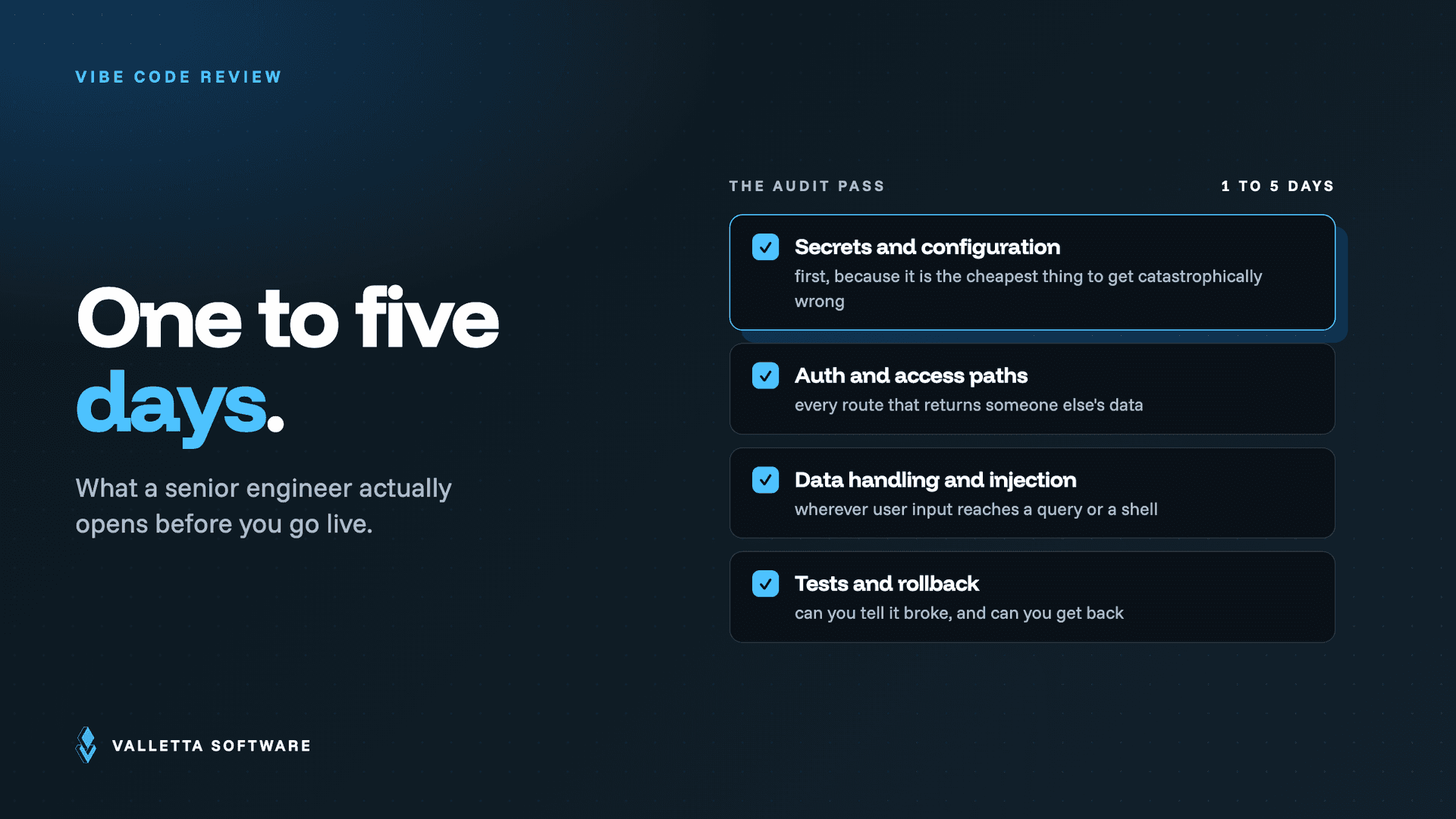

Auditing a vibe-coded app means doing three things that automated code review tools cannot: verify business-logic authorization, exercise the app under load and edge cases, and read the code with the assumption that the original author did not. The full audit takes a senior engineer 1–5 days depending on app size; the checklist below covers every category that matters before launch or fundraise. If the spot-checks raise concerns, book a senior-engineer review of your AI-generated codebase.
Key takeaways
- Three things automated review tools cannot do: verify business-logic authorization, exercise the app under load, and read the code assuming the author did not.
- A full audit takes a senior engineer 1 to 5 days, depending on scope.
- Seven categories any real audit covers: security, business logic, data integrity, performance, dependencies, observability, deployment.
- Audit before launch is 5x to 10x cheaper than fixing a post-launch incident.
Why automated code review tools miss what matters
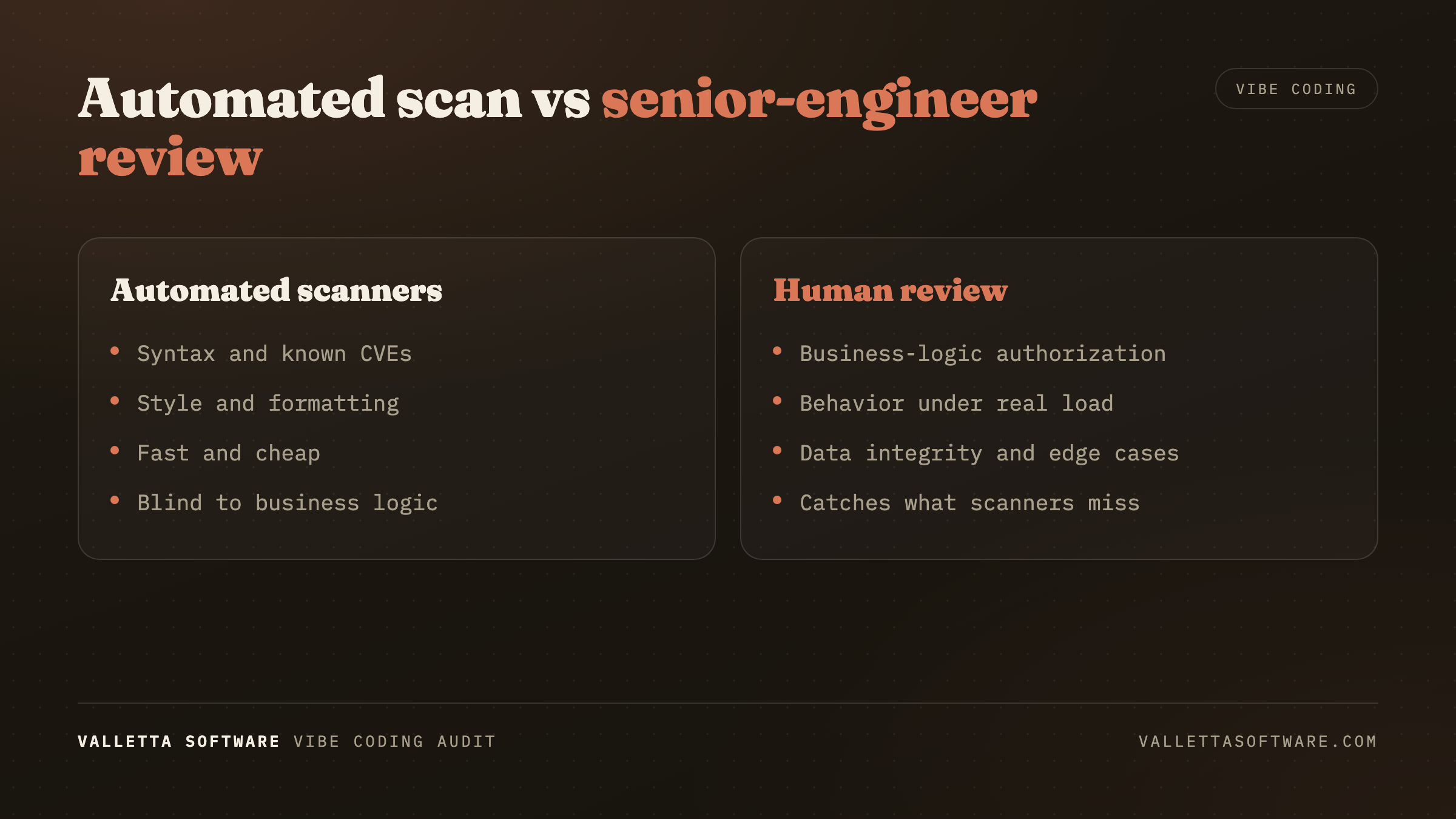
CodeRabbit, Greptile, Graphite, and similar tools are valuable, they catch a real class of bugs and they scale to every commit. What they do not catch is the class of bug that matters most in AI-built code:
- Missing logic. Scanners can't flag a permissions check that was never written. They see code that exists; vibe-coded apps fail on code that doesn't.
- Wrong assumptions. A function that returns the right output for the test cases but the wrong one for an unexpected input. The function is "correct" against itself.
- Architectural mismatch. The model wired up authentication one way in 80% of the codebase and a different way in the remaining 20%. Both work; only one is right.
These are not exotic findings. They show up in nearly every vibe-coded app we audit, because the model that wrote them was optimizing for "does it run" rather than "is it consistent." A human reviewer notices the inconsistency in the second function and asks why; a scanner reports that both functions pass.
The seven things a real audit checks
1. Authorization on every endpoint
Walk the routes file. For each authenticated endpoint, answer: who can call this, and is the check enforced? Then test the answer by calling the endpoint as a different user. If you can read or modify someone else's data, you have an IDOR, the single most common critical bug in vibe-coded SaaS.
2. Secrets and configuration hygiene
Grep for known secret prefixes (sk_, pk_, AKIA, ghp_, common patterns). Check the production bundle output, not just the source, secrets often leak through bundling. Verify every .env-style variable used by the client has a NEXT_PUBLIC_ or equivalent prefix and is genuinely safe to expose.
3. Input validation at trust boundaries
Every place user input crosses into the system, ask: is this validated, and does the validation match the assumption downstream? Common failures: a string that's validated for length but then used in a database query without parameterization, or a file upload that's checked for MIME type by trusting the client.
4. Rate limiting and abuse vectors
Map the endpoints an attacker would target: login, signup, password reset, contact form, and every LLM-backed feature. Each must have a rate limit. LLM-backed endpoints additionally need cost caps, the difference between a rate limit and a billing limit matters when one bad actor can run a $5,000 OpenAI bill against your account in an hour.
5. Dependency vulnerabilities
Run the language's native audit (npm audit, pip-audit, cargo audit) and review every High or Critical finding. Pay specific attention to transitive dependencies, the direct dependency may be safe while pulling in a vulnerable version of something three levels down.
6. Error handling and information disclosure
Confirm production error responses don't echo stack traces, environment variables, or database schemas. Test with deliberately malformed requests, the response codes and bodies should be terse. Disable any /debug or /admin/inspect routes that exist for development.
7. Production readiness
Observability, error tracking (Sentry or equivalent), basic uptime monitoring, backup strategy, deployment rollback, and a documented incident response. The audit confirms these exist; it doesn't require a 24/7 SOC, but it does require that someone will know within an hour if the app is down.
How to actually do it, the audit workflow
If you're running the audit yourself or watching someone else do it, the workflow is:
- Read the architecture map. Spend the first hour reading the entry points: routes, middleware, auth, database access. The goal is to understand what the app is, not to start finding bugs yet.
- Exercise the app. Sign up, log in, do every user action. Sign up as a second user and try to access the first user's data. Note what works and what shouldn't.
- Read the diff from defaults. Where does the code deviate from the framework's default configuration? Each deviation is a place to ask why and what the consequence is.
- Test the failure modes. Submit empty fields, oversized inputs, unicode edge cases, and deliberately malformed JSON. Note where the responses leak information or crash the server.
- Scan the bundle. Build the production bundle and search it for secrets, debug strings, and any obvious leaks.
- Run the automated tools. Now, not first. They catch the easy stuff after you've found the hard stuff.
- Write findings. One file. Severity, exploitability, fix effort, code reference. Sort by "fix first."
Code review vs code audit, the distinction that matters
The two terms are often used interchangeably, but they describe different scopes:
- Code review, a continuous practice during development. Every PR gets a second pair of eyes. Catches issues at the point of introduction.
- Code audit, a one-time deep dive. Reads the entire codebase as a finished artifact. Catches issues that survived ongoing review or that ongoing review never existed for.
Vibe-coded apps need an audit because they often skip the review stage entirely, there's no "second pair of eyes" when the only author is the AI tool. The first human review the code ever gets is the audit, which is why the findings can be substantial.
When to hire it out vs do it yourself
If you have the engineering background to follow the checklist above, doing the audit yourself is fine, and you'll learn things about your code in the process. The bar for self-audit:
- You've shipped a non-vibe-coded app to production before.
- You can read every line of your repo and know what it does.
- You're comfortable with at minimum auth flows, database queries, and HTTP middleware in your chosen stack.
If those three are true, the seven-step workflow above plus a weekend should get you a workable audit. If any of those is not true, hire a senior engineer for the review, the cost is small relative to the cost of finding an issue during diligence or after launch. The Valletta Vibe Coding Audit covers all of this, starting at $199.
What to expect in the deliverable
A good audit report should be a single document that a non-technical reader can act on. Minimum sections:
- Executive summary, two paragraphs, plain English, what's the risk and what's the recommendation.
- Critical findings, top 3–5 issues that block launch.
- Detailed findings, every issue with severity, exploitability, location in code, and concrete fix.
- Defer list, things noted but not blocking; revisit when scaling.
- Out-of-scope notes, what the audit didn't cover and why.
If the report is just a CSV export from a scanner, it's not an audit. The judgment, what to fix first, what to defer, what to redesign, is the value.
For founders shipping in the next 30 days
The fastest path to launch with confidence: run the seven-step checklist this week, fix the critical issues yourself, and book a focused audit on the remaining surface. If your launch is tied to a fundraise, the Investor-ready audit tier additionally produces a document you can hand to a diligence partner. For the underlying mechanics of how the app got built in the first place, our how-to-vibe-code guide covers the workflow this audit assumes you followed.
Source: the OWASP Code Review Guide.
Frequently asked questions
How long does a code audit take?
For a vibe-coded MVP under 5,000 lines, 1–3 business days. For mid-sized SaaS at 5,000–25,000 lines, 3–7 days. Anything larger is a custom scope.
How is a code audit different from a security review?
A security review focuses on vulnerabilities. A code audit covers vulnerabilities plus correctness, maintainability, performance, and production readiness. Most founders need the broader review; pure security reviews are appropriate when you've had recent broader audits and just need an adversarial perspective.
Can I just use CodeRabbit or Greptile?
Use them, they're good for what they do. They'll catch a real class of issues during development, before they reach an audit. They don't replace a human review for the categories of bug that matter most in AI-generated code (broken authorization, missing logic, architectural inconsistency).
What does an audit cost?
Senior-engineer audits start around $199 for small vibe-coded MVPs and scale with codebase size. Boutique firms in this space typically price $1,500–$10,000 for a complete audit. Pen tests are a separate engagement and usually start at $5,000.
Should I audit before or after my next round of features?
Before. The cost of fixing the same issue grows substantially once it has dependent code on top of it. Audit at the smallest stable point, fix, then build forward.
Frequently asked questions
- How do I review a vibe-coded app?
- Start with the auth layer, then secrets, then database access, then input validation, then deployment. A structured walkthrough beats spot checks.
- Who should review an AI-built app?
- A senior engineer who has shipped production software, not the same person who built it with the AI tool. External review catches the assumptions an insider misses.
- How long should a vibe-coded app review take?
- A small MVP can be reviewed in a day; a more complex SaaS in 3 to 7 business days. Larger codebases take a tiered approach: surface scan first, then deep dive on the highest-risk modules.
- What red flags signal a deeper audit is needed?
- Hardcoded secrets, missing auth on any endpoint, no input validation, environment configs committed to the repo, or duplicated logic across files.
- Should I use a checklist or hire an auditor?
- Use a checklist for early prototypes; hire an auditor before launch, fundraising or handoff. The cost of missing a single severe issue is far higher than the audit fee.
Get a Structured Vibe Coding Audit
External, senior-engineer review of your Cursor, Lovable, Bolt.new or v0 codebase. Risk-ranked report, fixed fee from $199.
Updated June 2026: the manual review checklist was reviewed for 2026 and the OWASP Code Review Guide was added as a reference.